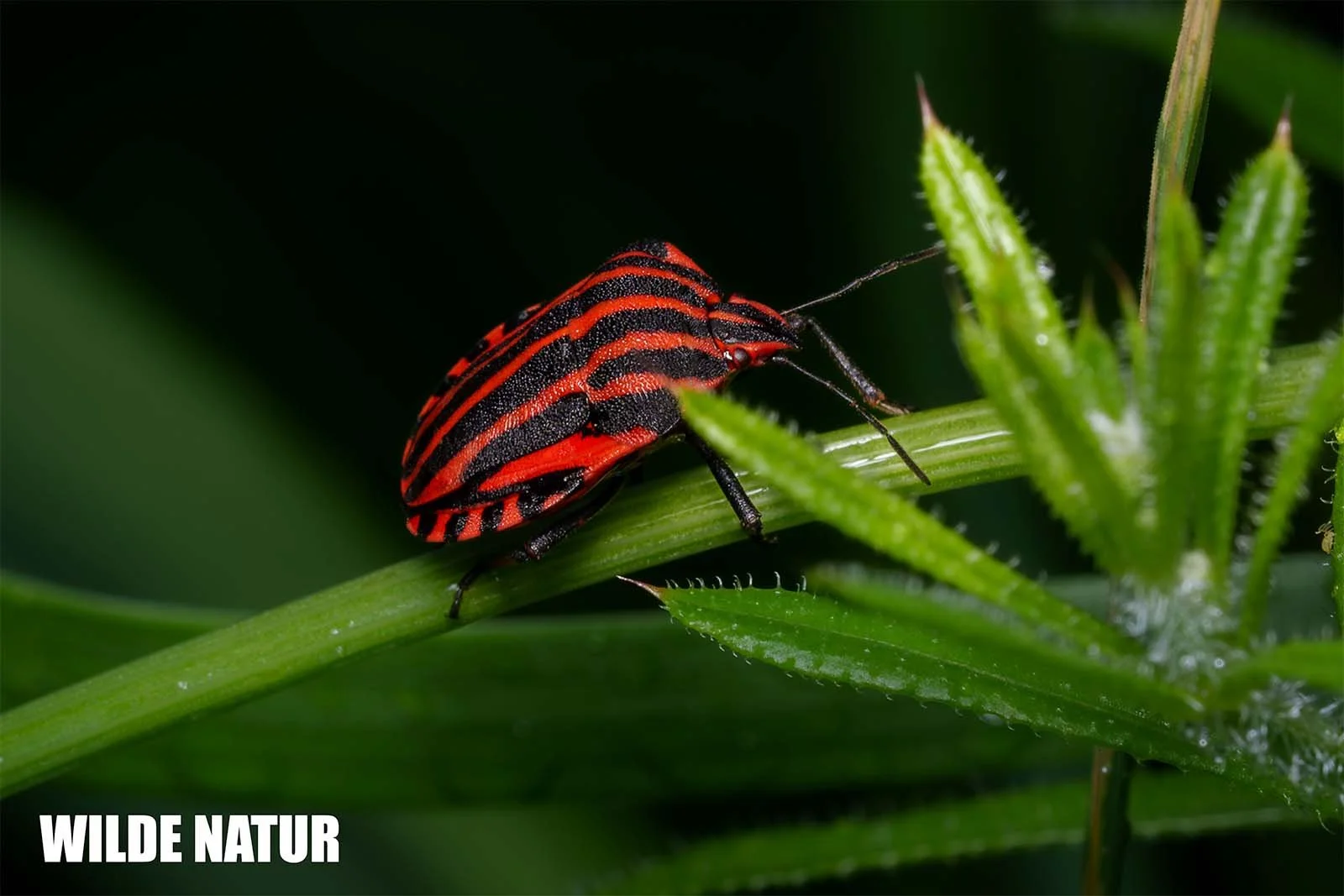
Striped bug (Graphosoma italicum)
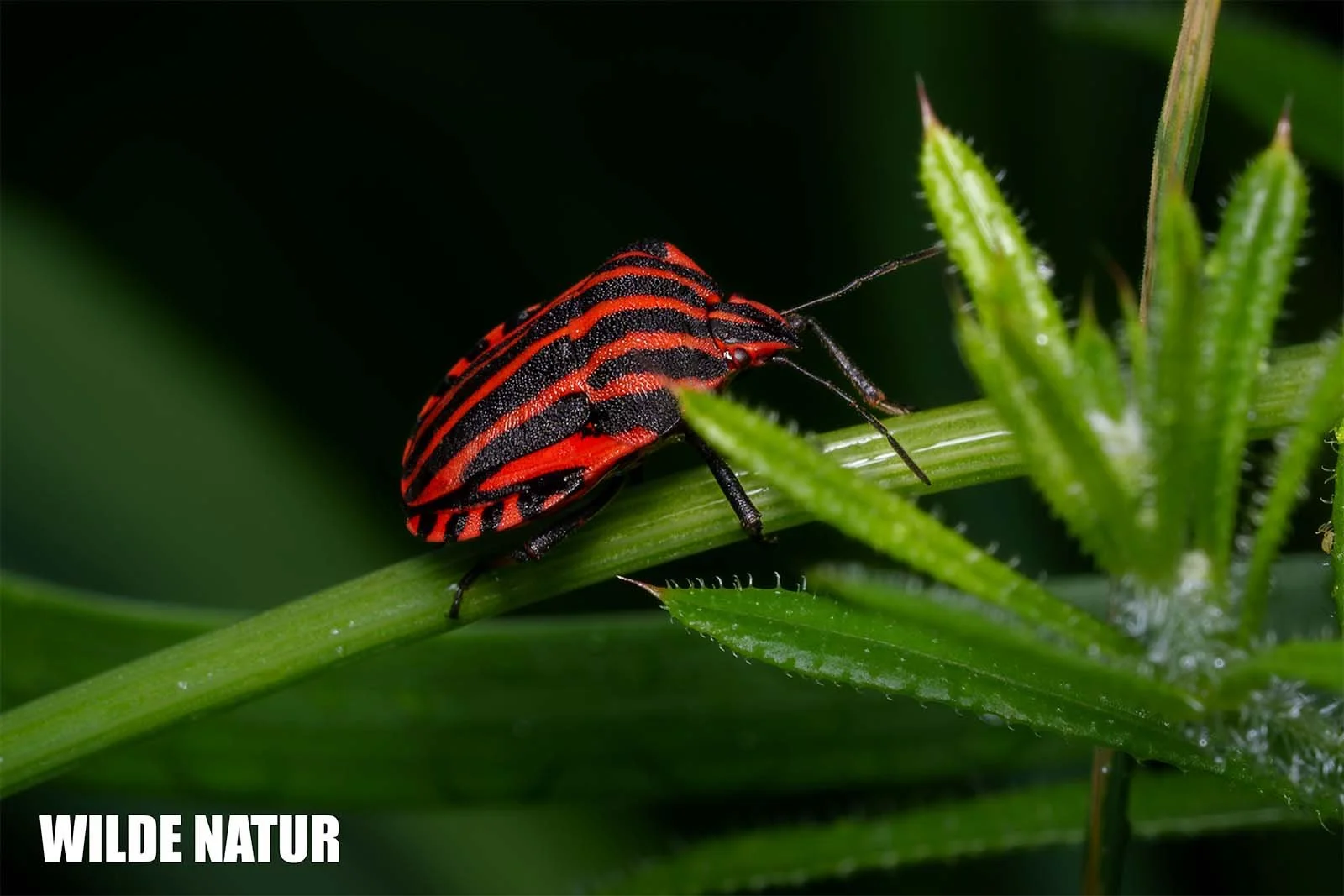
Striped bug (Graphosoma italicum)
Striped bug – recognising and understanding Graphosoma italicum
Discover the striped bug: appearance, lifestyle, distribution, and tips for wildlife-friendly gardens. Harmless, striking, and fascinating.
Key Facts
- Striking colouration: red-and-black striped shield
- Size: 8–12 mm
- Diet: plant sap – prefers umbellifers
- Behaviour: active from May to October, one generation per year
- Species name: Graphosoma italicum
- German name: Streifenwanze
- Family: stink bugs (Pentatomidae)
- Colour pattern: red with black longitudinal stripes
- Diet: plant sap, mainly umbellifers
- Reproduction: June–July; one generation per year
- Overwintering: as an adult bug
- Occurrence: Mediterranean region to Central Europe – expanding northwards
- Distribution: Western Palearctic – today reaching as far as southern Scandinavia
Table of Contents
- Introduction
- Appearance
- Typical characteristics
- Diet
- Reproduction and development cycle
- Seasonal behaviour
- Distribution and habitat
- Behaviour towards humans
- FAQ
Introduction
It immediately catches the eye: red with black longitudinal stripes, on sunny meadows, along paths, or in gardens—the striped bug (Graphosoma italicum) is truly eye-catching. But it is not only attractive; it is also a fascinating part of our native insect fauna.
Its striking warning colours are no coincidence: they deter predators. At the same time, it is completely harmless to humans—another good reason to take a closer look. In this article, you will learn everything about its features, lifestyle, and how you can observe or even encourage it in your garden.
Appearance
The striped bug is one of the most visually distinctive true bugs in Europe.
- Colouration: red body with black longitudinal stripes on the back, pronotum, and head
- Shape: broad, rounded, shield-shaped body typical of stink bugs
- Underside: reddish with black spots
- Antennae & legs: uniformly black – an important distinguishing feature from related species
- Size: 8–12 mm
The bright colours serve a clear purpose: warning. Such colour patterns are called aposematism—they signal to potential predators: “I don’t taste good!”
Typical characteristics
The striped bug is easy to recognise thanks to its bold striping. The key features at a glance:
- Black-and-red longitudinal stripes on the upper side
- Transverse striping across the head and pronotum
- Red underside with black spots
- Black antennae and legs
- Broad, domed, shield-shaped body
- Wing covers clearly visible, as it is often active
- Little resemblance to most native bugs, which are usually brown or green
Diet
The striped bug is strictly herbivorous. Its specialised tool is a piercing-sucking rostrum, which it uses to extract plant sap.
Main food source:
- Umbellifers (Apiaceae)
- wild carrot
- parsnip
- fennel
- dill
- angelica
- anise
- carrot
The bug feeds specifically on seed heads, stems, and unripe fruits. The juveniles—known as nymphs—are often found early on the same plants and feed in a similar way.
Reproduction and development cycle
The striped bug produces only one generation per year—it is described as “univoltine”.
Mating
- Usually in early summer (June)
- Bugs mate in the sun on umbellifer plants
- Often clearly visible, as they hardly hide
Egg laying
- Females lay eggs on umbellifer plants
- Eggs are small and barely visible
- Development proceeds directly through several nymph stages
Nymph stage
- From July: small, wingless juveniles on host plants
- Several moults until the adult stage (by late summer)
Adult bugs
- From late summer: the new generation is fully developed
- Overwintering occurs in the adult stage
Seasonal behaviour
From spring to autumn, you can observe the striped bug in nature, following these stages:
- Spring (May): first activity of overwintered adults
- June/July: mating and egg laying
- Late summer (August/September): nymphs develop into adults
- Autumn (October): retreat into overwintering sites
- Winter: as adult bugs in leaf litter or under plant debris
Thanks to their tolerance of cold, striped bugs survive the winter in sheltered locations.
Distribution and habitat
Originally native to the Mediterranean region, Graphosoma italicum has been spreading northwards for several decades—an effect also linked to climate change.
Today found in:
- Most of Germany (except the northwest)
- Southern Scandinavia (southern Sweden, Jutland)
- Central Europe, southeastern Europe, and western Asia
Typical habitats:
- Sunny meadows
- Dry grasslands
- Ruderal areas
- Roadsides and paths
- Gardens with wild plant elements
The bug prefers warm, open, and dry sites—the more umbellifers, the better.
Behaviour towards humans
The striped bug is completely harmless.
- It does not bite, even when threatened
- When disturbed, it may release a defensive secretion—this smells unpleasant but is not dangerous
- Its striking colouration signals unpalatability—effective against birds, but irrelevant to humans
You can therefore observe it safely, even from close range.
FAQ
1. Is the striped bug poisonous?
No. It is neither poisonous nor dangerous—not even for children or pets.
2. Can it damage plants?
In gardens, it does not play a significant role as a pest. Feeding damage is minimal and limited to seed heads.
3. How can I encourage it?
Let umbellifers grow—wild carrot, dill, and parsnip are perfect host plants.
4. Where does it overwinter?
In dry leaf litter, under plant material, or in crevices—preferably undisturbed.
5. Can it be confused with other bugs?
Yes, but its black legs and clear longitudinal stripes make it easy to identify.