Yellow sac spider (Cheiracanthium punctorium)
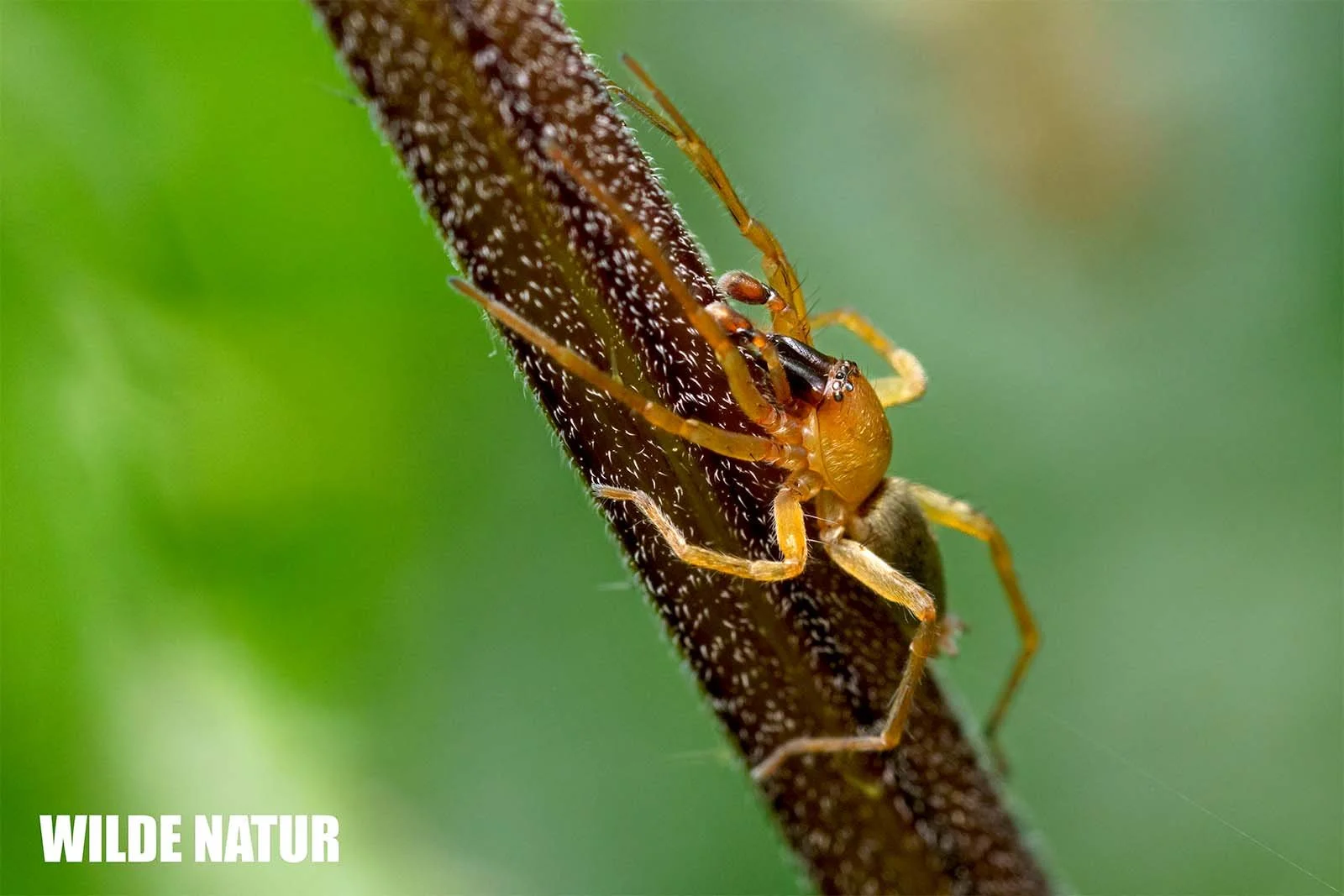
Yellow sac spider (Cheiracanthium punctorium)
Yellow sac spider – a profile of a striking spider
Yellow sac spider: profile, life cycle, distribution, and how to assess and interpret encounters with this striking spider.
Key Facts
- Colouration: orange-red cephalothorax, yellow-green abdomen
- Size: females 10–15 mm, males 7.5–12 mm
- Venomous bite: painful, but not life-threatening
- Behaviour: nocturnal, strongly defensive brood-care behaviour
- Species name: Cheiracanthium punctorium
- German name: Ammen-Dornfinger
- Lifestyle: solitary, living in the ground layer and vegetation
- Active season: June–October
- Distribution: southern, central and eastern Europe; increasingly common in central Europe
- Special feature: females defend eggs and spiderlings
Table of Contents
- Introduction
- Appearance
- Typical characteristics
- Diet and hunting behaviour
- Reproduction and development cycle
- Seasonal behaviour
- Distribution and habitat
- FAQ – Frequently asked questions
Introduction
Hardly any native spider is as striking—and at the same time as misunderstood—as the yellow sac spider. With its orange-reddish forebody, powerful chelicerae, and yellow-green abdomen, it stands out even to inexperienced observers.
In the summer months, the species is active in certain habitats in central Europe. Due to climate change—especially milder winters—Cheiracanthium punctorium is spreading farther north. This leads to more sightings, but also to uncertainty. This article puts the species into perspective: from appearance and lifestyle to a realistic assessment of its bite.
Appearance
The yellow sac spider is one of Europe’s more eye-catching spiders—less because of its size than because of its strong colouration and distinctive build.
The cephalothorax (prosoma) is usually orange to reddish, matte to slightly glossy. The chelicerae are particularly noticeable: robust, orange in colour, and black at the tips.
The abdomen (opisthosoma) is yellowish to greenish and often shows a diffuse darker patch on the front part of the back (cardiac mark).
The legs are long, slender, and pale yellow; the tips of the feet may appear darker. The eight eyes sit in two transverse rows and are relatively small.
In males, a thorn-like projection on the pedipalps can be seen—this is what the German name “Dornfinger” refers to.
Typical characteristics
- Strongly coloured, orange-reddish cephalothorax
- Very robust, conspicuous chelicerae
- Long first pair of legs
- No hunting web
- Nocturnal, hidden in silk retreats during the day
- Pronounced defensive brood-care behaviour in females
This combination makes the yellow sac spider relatively easy to recognise in central Europe.
Diet and hunting behaviour
The yellow sac spider is an active hunter. It does not build a capture web; instead, it searches for prey in vegetation, especially at dusk and at night.
Typical prey:
- grasshoppers
- beetles
- flies
- moths
- other insects of similar size
The spider approaches carefully, strikes with lightning speed, and delivers a targeted venomous bite. The prey is then carried to a hiding place and eaten there.
Reproduction and development cycle
Reproduction begins in mid to late summer (from July).
Mating
Males actively search for females. After copulation, they move away again; their further life history is poorly documented.Egg-laying in August
The female produces a white, dense silk retreat attached to plant stems and lays up to 300 eggs inside.Guarding
The female stays with the clutch and defends eggs and spiderlings consistently against disturbance.Hatching and development
After 3–5 weeks, the spiderlings hatch, build small retreats of their own, and overwinter inside them.One-year generation
The adults die in autumn; a new generation grows up the following year.
Seasonal behaviour
- June–August: activity phase, mating, egg-laying
- September–October: spiderlings hatch
- Autumn/Winter: overwintering as juveniles
- Spring: growth and moulting
The yellow sac spider is predominantly nocturnal. During the day it rests well hidden in its silk retreats in tall vegetation.
Distribution and habitat
Originally mainly distributed in southern and eastern Europe, Cheiracanthium punctorium is now also recorded more frequently in central Europe.
Preferred habitats include:
- sunny meadows and dry grasslands
- railway embankments
- open, structurally rich areas with tall vegetation
Its northward expansion is most often linked to milder winters and longer growing seasons.
FAQ – Frequently asked questions
1. Is the bite of the yellow sac spider dangerous?
The bite can be painful, similar to a wasp sting. For healthy people it is not life-threatening.
2. How common is the species in Germany?
Still regionally limited, but increasingly found in suitable habitats.
3. Should you remove the silk retreats?
No. They are used for reproduction and should be left undisturbed.
4. How can you support the species?
By maintaining near-natural meadows, mowing less often, and preserving structurally rich areas.
5. Is the species protected?
Not directly, but many of its habitats are protected indirectly.