Train Your Skills with Your Telephoto Lens

Important Techniques for Using Telephoto Lenses
Improving Stability and Sharpness
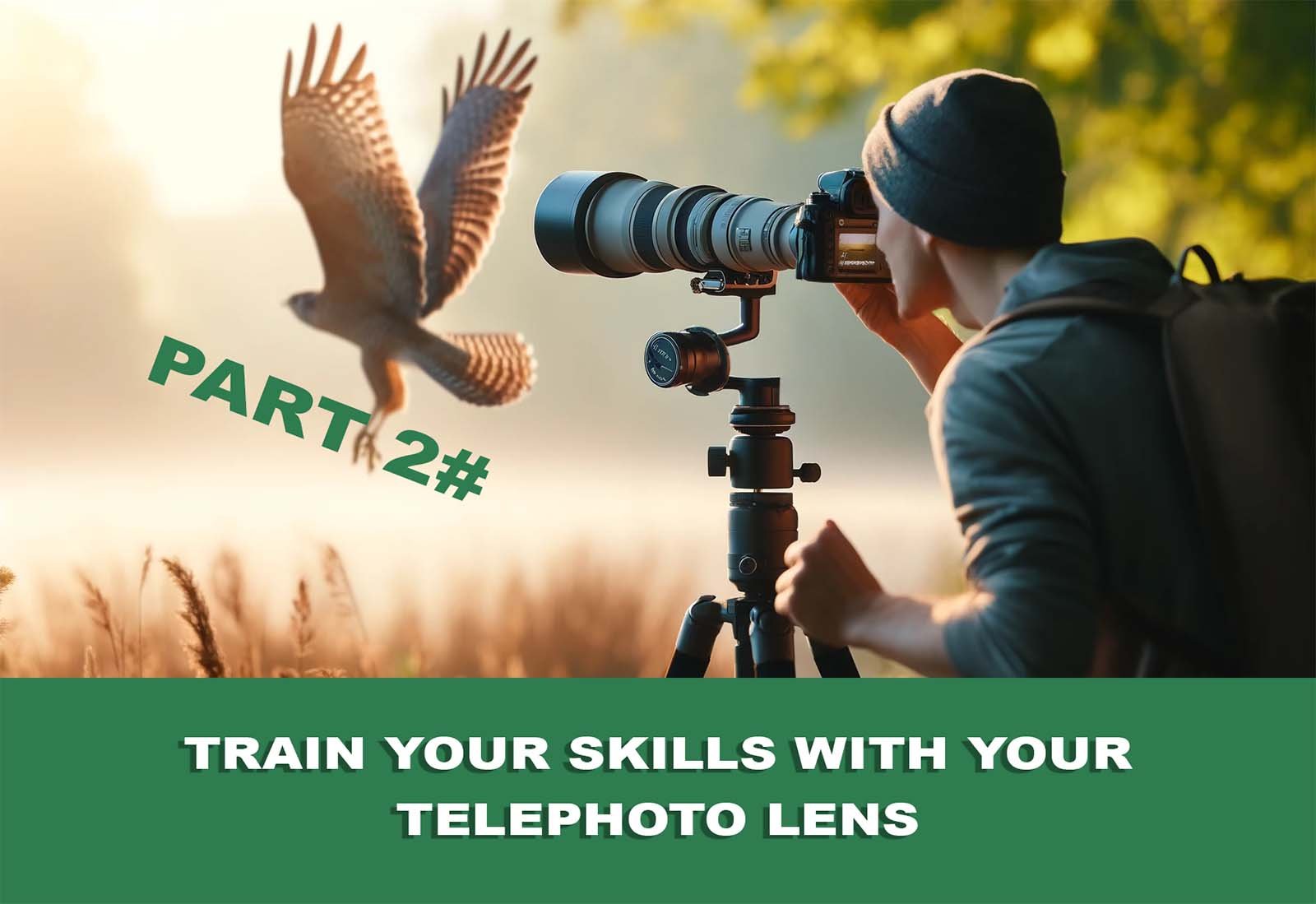
Telephoto lenses are large and heavy, requiring good technique in the field to achieve the best possible results. Camera movements and vibrations are amplified and, if not compensated for, lead to blurry images. Image stabilization helps, but a stable tripod or monopod is still a good decision – you shouldn't forgo it, otherwise, you often won't achieve the sharpness the lens can deliver. Handheld use of heavy lenses is only effective for short periods.
Choosing the Right Tripod and Tripod Head
Even in low light conditions, a tripod helps avoid overly shortening the exposure time. Especially with telephoto lenses that are not very bright, such as the Sony 200-600 mm f5.6/6.3 G OSS, SIGMA 150-600 mm F5-6.3 DG OS HSM, SP 150-600 mm F/5-6.3 Di VC USD G2, or Canon RF 100-500 mm f4.5/7.1, a stable tripod can help. A suitable tripod head, such as a gimbal head, also makes it easier to smoothly track moving subjects. One of my favorites is the FlexShooter Pro with lever clamp, which is also particularly suitable for travel.
Practical Exercises and Routines
Balancing Your Camera Equipment
It is important to properly balance the lens with the camera on your tripod head or gimbal. This should be practiced to save time on-site and keep the position stable that you have aligned the camera to. With telephoto lenses that have external focusing, the center of gravity shifts when zooming, which makes balancing more difficult compared to internal focusing lenses.
Effective Handling in Low Light Conditions
Especially with fixed focal lengths, it is often necessary to quickly assemble the lens and attach it to the camera, essentially in the dark. A certain routine in assembly and mounting on the tripod ensures that you are ready in a few minutes without having to think long. This also reduces disturbance at your hide or position, so the animals do not immediately spot you.
Special Skills and Settings
Accurately Capturing Subjects
The ability to capture subjects through the viewfinder without long searching is crucial. Especially with telephoto lenses of 400 mm or more, it is a challenge to fix a bird in flight in the viewfinder. This should be practiced to avoid missing shots.
Useful Lens Settings
Learn the settings of your telephoto lens and understand when they are useful. Whether it is to extend the minimum focusing distance for faster autofocus performance, or to save a fixed focus point and retrieve it anytime with a custom button on the camera. Various stabilization modes can also be helpful in different situations.
Practical Examples
Kingfisher in a Dive
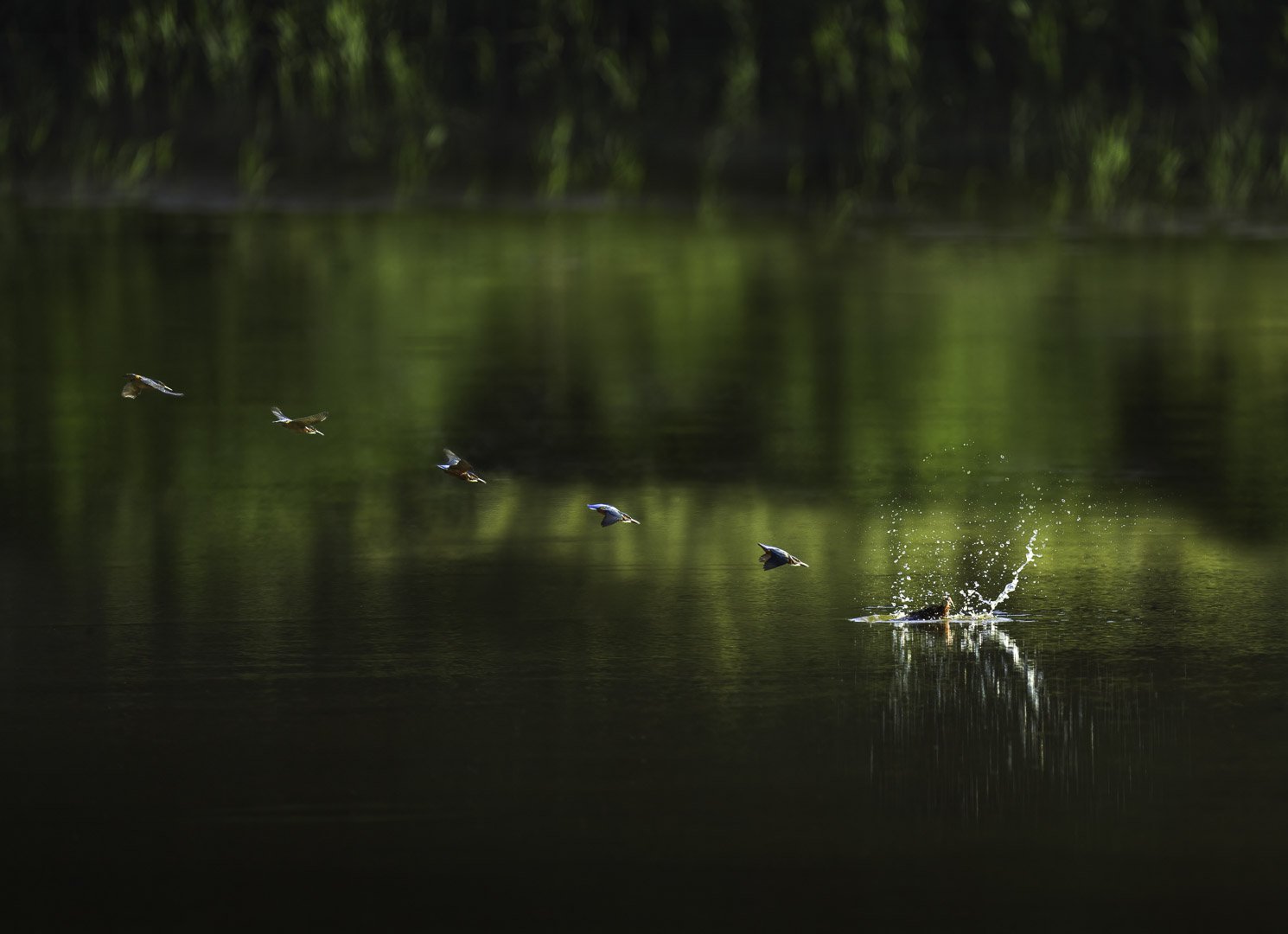
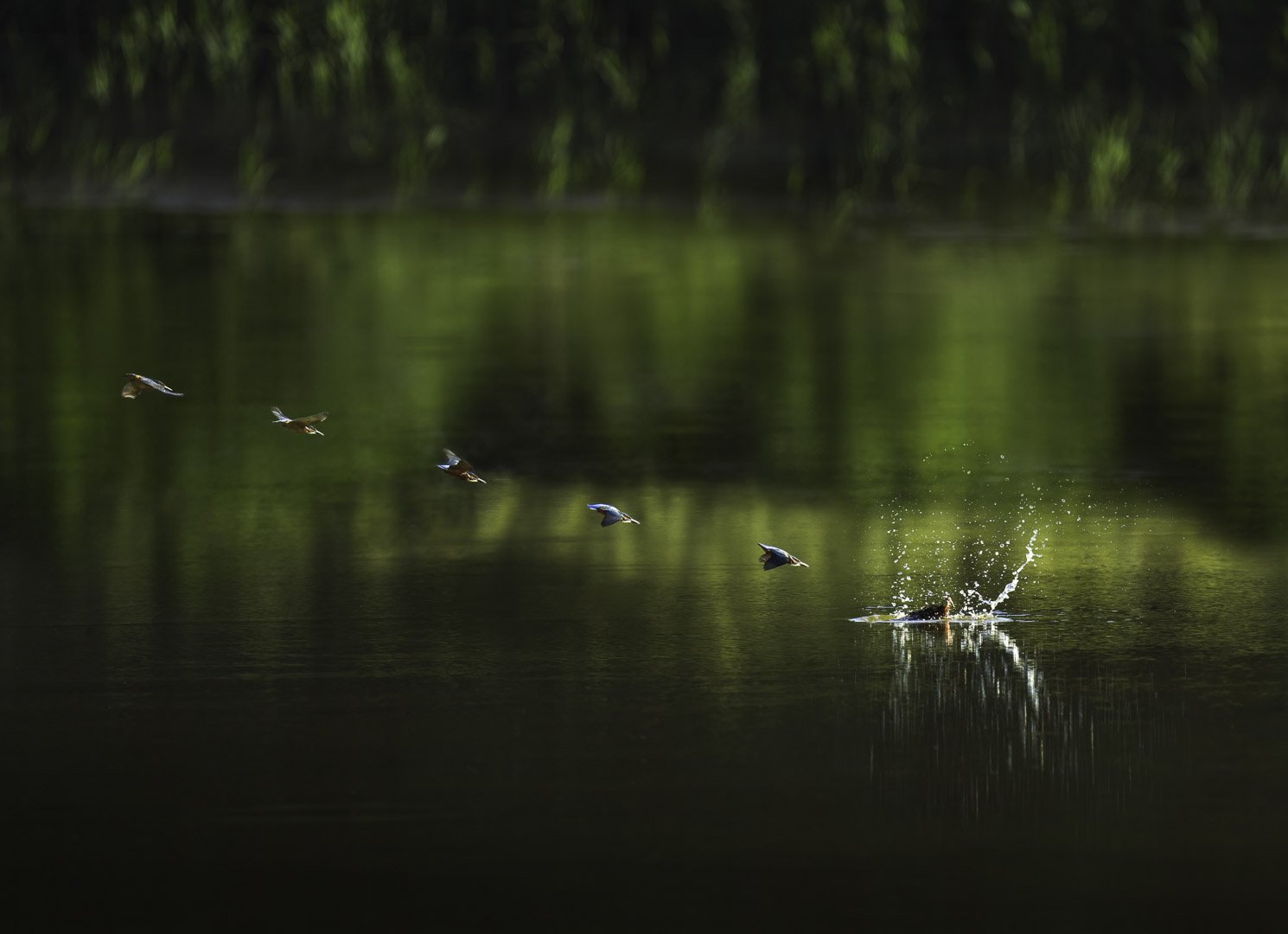
Kingfisher diving sequence summarized in a single image from a series of shots.
An example of capturing and tracking subjects in the viewfinder is the kingfisher. These small, fast-flying birds are well-camouflaged despite their bright colors. Capturing a kingfisher in flight and keeping it in the viewfinder is a challenge, especially at long focal lengths.
Osprey in the Early Morning Rain

Female osprey photographed in heavy rain under poor weather conditions with an 840 mm f/9 lens on a tripod.
Sony a7RIV + Sony 200 - 600mm F5.6 / 6.3 G + Stativ: Berlebach UNI 22C
Another example from my experience is photographing an osprey in the rain with a 200-600 mm f5.6/6.3 lens and a 1.4x teleconverter, extending the focal length to 840 mm but reducing the brightness to f9. To keep the exposure time low, I used a stable Berlebach wooden tripod that absorbs vibrations excellently. This way, I could document a female osprey during her nesting period in 2022, despite the challenging light and weather conditions.
FAQ – Training Your Telephoto Technique
Why is proper handling of a telephoto lens so important?
Telephoto lenses are large, heavy, and very sensitive to camera shake. Even small movements can noticeably reduce image sharpness.
Why are image stabilizers often not enough on their own?
Image stabilization helps, but it cannot fully compensate for strong vibrations and camera movements at long focal lengths. A tripod therefore remains essential.
When should you use a tripod or monopod?
Whenever you work with heavy telephoto lenses or when the light conditions require longer exposure times.
Why is a gimbal head particularly suitable for telephoto lenses?
A gimbal head allows you to move heavy lenses almost weightlessly and to track flying or running animals smoothly.
Why is it so important to balance the camera on the tripod?
Only a correctly balanced camera–lens combination stays stable in the desired position and allows controlled movement.
What problems arise with zoom lenses that extend externally?
Zooming shifts the center of gravity, which changes the balance and reduces stability.
Why should you practice setting up your camera gear?
A well-practiced setup saves time, prevents stress, and minimizes disturbance at the shooting location—especially important when photographing shy wildlife.
Why is it so difficult to quickly locate the subject in the viewfinder?
At focal lengths of 400 mm and above, the field of view is very narrow, which makes it harder to acquire fast-moving subjects such as birds in flight.
Which lens settings are particularly helpful for telephoto lenses?
Minimum focus distance, focus limiter, memory focus positions, and different stabilization modes can significantly speed up autofocus performance.
Why is a stable tripod especially important in low light?
When light is limited, you need longer exposure times—without a stable tripod, the risk of blurred images increases sharply.