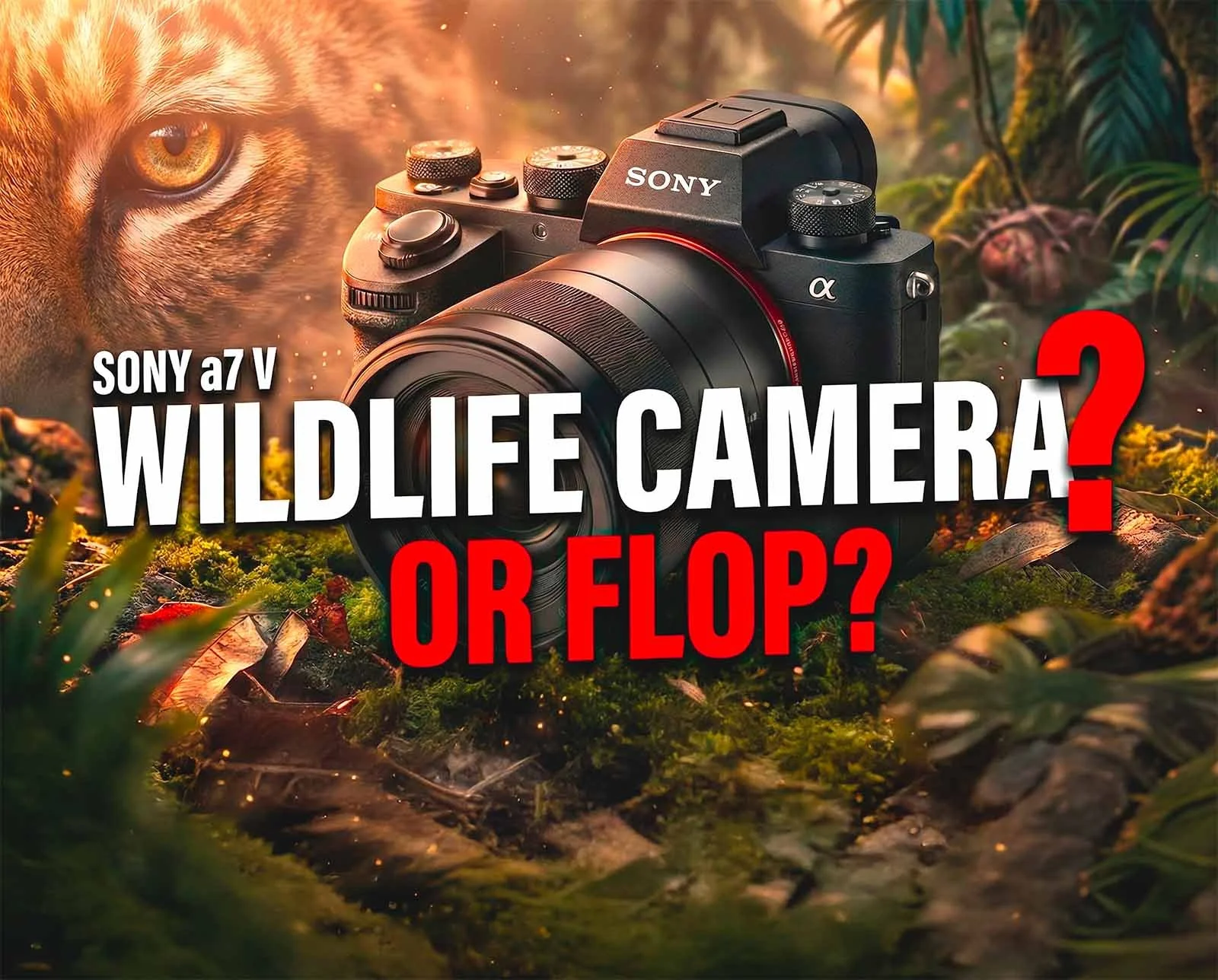
Sony a7 V – Wildlife camera or flop?
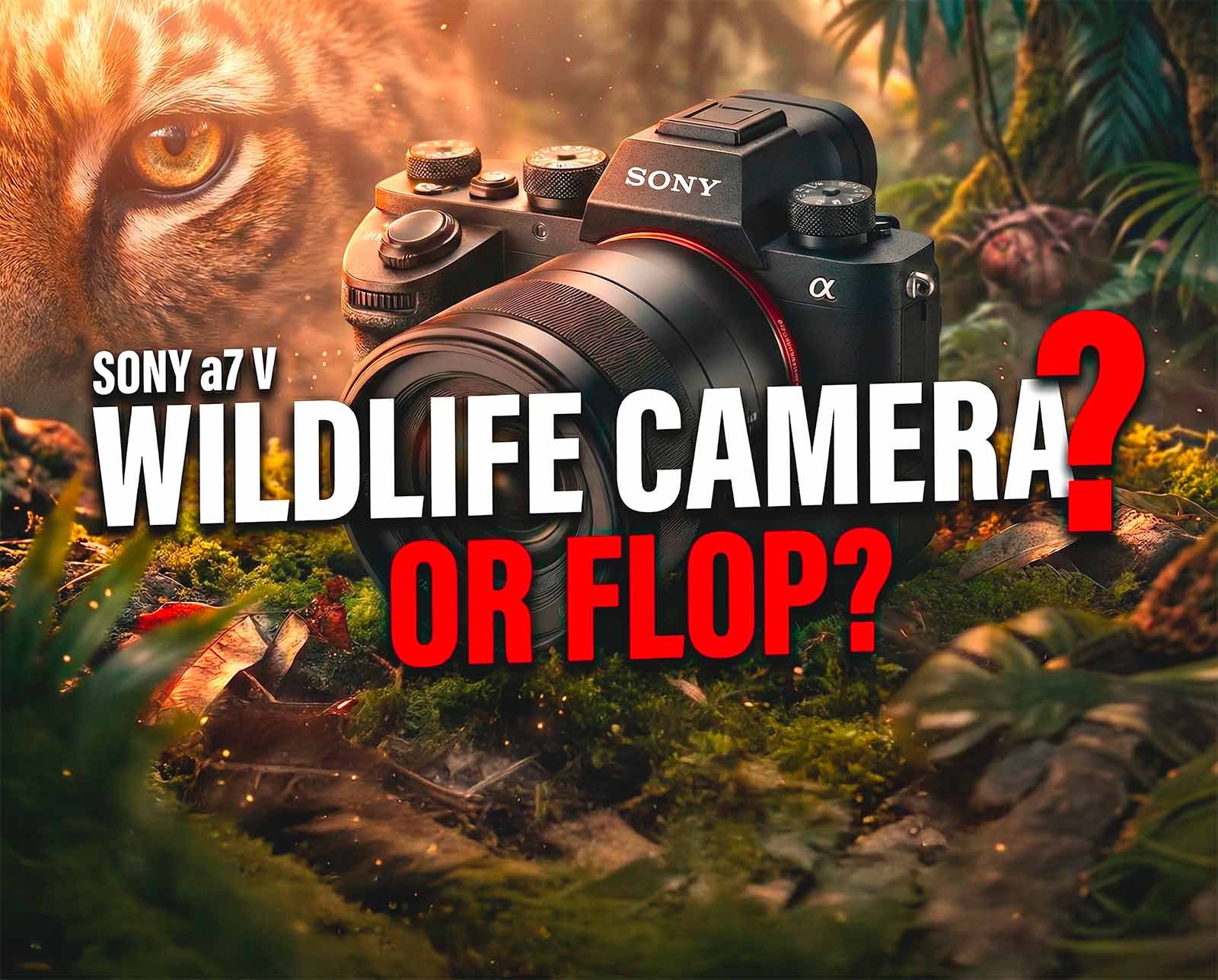
Sony a7 V - The key facts at a glance
- 33 MP Exmor RS full-frame sensor
- BIONZ XR2 processor
- 759 AF points, approx. 94% coverage
- AI-based subject recognition - insects, vehicles, birds, etc.
- 30 fps with AF/AE tracking
- Greatly reduced rolling shutter - partially stacked sensor
- Pre-capture up to 1 s before shutter release
- Dynamic range up to 16 EV
- AI-based auto white balance
- 4K 60p oversampled from 7K (full frame)
- 4K 120p in APS-C - 1.5x crop
- Up to 7.5 EV 5-axis in-body image stabilisation
- New 4-axis multi-angle touchscreen (tilt + swivel)
- Improved energy efficiency & optimized heat management
- Weight approx. 610 g body only & 695 g with battery + memory cards
Table of Contents
- Finally official – clear facts at the end of the year
- Partially stacked sensor - more speed, less rolling shutter
- Familiar subject recognition with more power
- High burst rate finally arrives in the mid-range
- Highlight: Pre-capture function
- Speaking of speed - what about write performance?
- 120 fps in 4K with APS-C crop
- Conclusion: Wildlife camera or flop?
- FAQ – Sony a7 V for wildlife & nature film
Finally official - clear facts at the end of the year
It’s been eagerly awaited and has probably been the most discussed camera of recent months. Now it’s finally here, the new Sony camera in the a7 series - the Sony a7 V.
For a long time there were rumors, leaks, expectations, and wishlists from Sony users. Now it turns out that much of what appeared on those wishlists or circulated as rumors was not just hot air but has actually been implemented.
On paper, the new Sony a7 V is not just a minor update and successor to the a7 IV, but a clear step forward. It delivers professional performance for demanding nature photographers and focuses on speed, endurance, and cutting-edge AI technology - all of which are very helpful under outdoor conditions.
Partially stacked sensor - more speed, less rolling shutter - finally
For me, the first fantastic news was the partially stacked sensor. The competition has already moved in this direction with its latest releases.
Over the last few months, some of you wrote to ask whether you should buy the a7 IV now or wait for the a7 V. There’s no simple “right/wrong” answer to that. What I did say, though, was this: if the a7 V can’t shoot in e-shutter mode with greatly reduced rolling shutter, it wouldn’t be a real upgrade worth buying - at least for my use cases.
There are several reasons for that, one of which is the continuous shooting speed, which is especially important in bird photography. With the a7 V this has now been implemented - or at least to a large extent. It remains to be seen how it performs in real-world use.
Partially stacked sensor - what does that mean?
A partially stacked sensor is an architecture where part of the electronics is moved to a second layer. You can imagine it like a desk that gets an extra shelf: tasks are distributed over two levels and can therefore be processed faster. In the same way, the sensor can read out image data significantly faster than models such as the a7 IV or a6700.
This results in higher continuous shooting rates and a noticeably reduced rolling shutter effect in electronic shutter mode. So yes, a real step forward - until now this level of performance was limited to the a9 and A1 series.
Familiar subject recognition with more power
As with recent Sony releases, the subject recognition in the a7 V has been brought up to the current technical standard. Since even the compact a6700 already offers these functions, this isn’t so much a real “upgrade” as it is something users simply expect.
There isn’t a lot more to say about it in theory. What really matters is whether the updated AI subject recognition is actually more accurate in practice than in previous models that introduced this technology. According to Sony, the a7 V offers a 30% improvement in real-time recognition performance compared to the a7 IV.
High burst rate finally arrives in the mid-range
What other manufacturers were already offering in the mid-range with their latest releases is now finally available in the a7 V as well: a powerful electronic shutter that is fast enough to be used without major limitations. Until now, this level of performance was reserved for Sony’s flagship bodies - from the a9 series up to the A1.
Thanks to the new sensor technology, the Sony a7 V becomes particularly interesting for wildlife photography. It can shoot at 30 frames per second - with no viewfinder blackout - and operates completely silently. The full 14-bit color depth is maintained at maximum performance, depending on the chosen settings. That’s a big advantage in wildlife photography.
There’s also a very pragmatic benefit: there is no mechanical wear, which contributes to sustainability and extends the life of the camera. Even if you like to upgrade to the latest technology, this means a camera can be used for longer without constantly worrying about shutter count and when it might “wear out”. With high burst rates, it’s easy to rack up several thousand actuations per month - a clear argument against a mechanical shutter that would quickly reach its limits.
The a7 V also brings along a special feature borrowed from the A9 III: the Speed Boost function. This allows you to call up the full 30 fps only when needed by pressing a predefined button. A massive benefit for photographers who mostly work in single-shot mode, but want instant access to the full burst speed when things get serious.
The highlight: Pre-capture function
Another feature that will especially delight bird photographers is the pre-capture function - something I miss a lot on my A1 (Gen 1). This long-awaited capability has now finally made its way into Sony’s mid-range. What’s missing from flagships like the A1 (Gen 1), and won’t be added via firmware, will be available to future a7 V owners for wildlife photography.
What can the pre-capture function do?
The pre-capture function starts recording as soon as the shutter button is half-pressed. The camera continuously buffers images for up to one second. When you fully press the shutter, it not only saves the frames from that moment on, but also those captured in the second beforehand.
This way, even abrupt, almost unpredictable movements - like a bird suddenly taking off - are captured instead of being lost due to human reaction time.
Speaking of speed - what about write performance?
This is where we get to a very interesting and important topic. Experienced bird photographers know that the chance of keeping that small songbird or large raptor in action for as long as possible stands and falls with the camera’s write speed to the memory cards.
The a7 V has, in addition to the familiar dual SD card setup, gained a CFexpress card slot. At first glance, that’s great - it allows the camera buffer to be cleared more quickly. How exactly card management is implemented remains to be seen.
Card management - what do I mean by that?
In the past, Sony cameras with dual slots could be configured very flexibly: one slot could be used as the main storage, the other as backup. You could also split formats, for example, RAW to slot 1 and JPEG to slot 2 - no problem.
However, there was one crucial downside when using both cards as main & backup: as soon as SD cards with different read/write speeds were used, the camera would always run at the speed of the slower card. Technically that’s logical, but in practice it meant you were constantly “driving with the handbrake on.”
So how does this work in the Sony a7 V?
If you use a CFexpress card together with an SD card, the question is whether you have to give up an in-camera backup to the SD card to achieve maximum performance.
Since the a7 V only provides a single CFexpress slot and the second slot supports SD cards only, there will always be a technical speed difference between the two. Writing a simultaneous in-camera backup to the SD card is therefore only possible if you’re willing to accept a performance hit.
For maximum performance - such as 30 fps bursts, pre-capture or 4K 120p - using a CFexpress card as the sole primary card is clearly the better choice.
120 fps in 4K but with APS-C crop
Another addition that made it into the Sony a7 V is 4K at 120 fps. This is especially exciting for wildlife filmmakers, as it enables slow-motion footage at high resolution.
Videographers who focus primarily on video might not be thrilled about the APS-C crop that is applied at 120 fps in 4K. For pure video work, a different body might be more suitable.
However, for hybrid shooters, this APS-C crop at 120 fps can actually be an advantage. The 1.5x crop effectively extends your reach - your 600 mm frame becomes equivalent to 900 mm. For small songbirds, that’s often a welcome “bonus teleconverter.”
From 4K 60 fps downward, the Sony a7 V uses the full sensor width without crop. In Full HD, it even offers up to 250 fps, enabling up to 10x slow motion, a powerful tool for bird behavior shots.
Is that all?
That was a selection of standout features that, in my perspective, represent a huge improvement for wildlife and bird photography. There are certainly more aspects one could discuss, but I think these are among the most eagerly awaited features for nature photographers in the Sony ecosystem.
Of course, things like a dynamic range of 16 stops are not unimportant, but Sony has already been strong in this area for several years, so depending on what camera you’re coming from, this may not be the decisive factor.
My Conclusion - Wildlife Camera or Flop?
We’re talking about a mid-range hybrid full-frame camera, which is certainly not cheap, but whose features justify the price provided it delivers in practice what it promises on paper and in early tests.
Current reviews, for example on YouTube, are still based on pre-production models and non-final firmware, so we’ll have to wait and see how the camera performs in real-world use. Particularly interesting will be the RAW burst performance, buffer depth, and write speed when a CFexpress and an SD card are used simultaneously.
The first impression of the Sony a7 V is that it is not a routine update to the a7 IV. The partially stacked sensor, high-speed electronic shutter at 30 fps, pre-capture function, and greatly reduced rolling shutter bring exactly those features into the mid-range that many wildlife photographers have been waiting for - especially those currently using the a7 IV.
With significantly more speed, a blackout-free viewfinder, and silent operation, the a7 V offers a very compelling package for wildlife shooters.
In the video department, 4K 120 fps adds extra creative options, such as 5x slow motion - even if the APS-C crop won’t be everyone’s favorite.
All in all, the Sony a7 V is a consistent and long-overdue evolution that turns it, for the first time, into a genuine high-speed wildlife camera in the mid-range segment.
FAQ – Sony a7 V for Wildlife & Nature Film
1. Is the Sony a7 V a good wildlife camera?
Thanks to its fast autofocus, 30 fps burst rate, pre-capture function, and AI tracking, the Sony a7 V is very well suited for wildlife photography, especially birds in flight. Among mid-range hybrid full-frame cameras, it becomes a particularly attractive option.
2. What does the partially stacked sensor of the Sony a7 V offer in practice?
The partially stacked sensor in the a7 V enables a fast readout. This results in reduced rolling shutter distortion, faster autofocus, and higher burst rates. In practice, this means moving subjects can be captured more precisely and with fewer distortions when using the electronic shutter - particularly useful in wildlife and sports photography.
3. How important are the 30 fps of the a7 V for wildlife?
For birds in flight, raptors hunting, or generally very fast action (e.g. songbirds taking off), the high frame rate significantly increases your hit rate, because more critical moments are captured within a short time.
4. What is the pre-capture function of the Sony a7 V good for?
The camera saves images even before the shutter is fully pressed. This way, unpredictable moments - such as a bird suddenly taking off - don’t get lost. Without this feature, such moments are easily missed due to human reaction time.
5. Is there viewfinder blackout at 30 fps on the a7 V?
No. In continuous shooting mode, the a7 V has no viewfinder blackout, making it much easier to track subjects. For birds in flight, this greatly improves the chances of capturing the perfect frame - especially when you only have one chance.
6. Does the a7 V maintain full 14-bit color depth in electronic shutter?
Yes, the Sony a7 V can deliver full 14-bit color depth in electronic shutter mode, assuming appropriate settings. Very high ISOs or certain advanced shooting modes can reduce effective bit depth - but that’s true regardless of whether you use a mechanical or electronic shutter.
7. How good is the new AI subject recognition of the a7 V?
It recognizes animals, birds, insects, vehicles, and more. Sony claims a 30% improvement in real-time recognition performance over the a7 IV. Final judgment will, however, depend on real-world experience.
8. Does the a7 V apply a crop at 4K 120 fps?
4K at 120 fps is recorded with an APS-C crop (1.5x). For nature filmmakers, this can actually be an advantage, as it effectively brings distant subjects closer. From 4K 60 fps downward, the full sensor width is used without crop.
9. What is the best memory card setup for maximum performance with the Sony a7 V?
The a7 V has one CFexpress Type A slot and one SD slot. For maximum performance - especially with high burst rates and 4K 120 fps - you should use a fast CFexpress card as your primary card. It offers much higher write speeds than SD cards.
10. Who will benefit most from upgrading to the Sony a7 V?
Mainly wildlife photographers currently using an a7 IV, older Sony bodies, or smaller models who want more speed, a better electronic shutter, pre-capture, and reduced rolling shutter.
But also newcomers to full frame and ambitious or professional wildlife shooters will find the a7 V to be a powerful tool for nature and animal photography.
11. Can I still use my existing Sony lenses on the a7 V?
As long as they are E-mount lenses. Sony uses the E-mount across its cameras, so all E-mount lenses can be used on any Sony body with an E-mount, whether APS-C or full frame.
12. Can I use my old Sony batteries in the Sony a7 V?
Since 2017, most Sony cameras have used the NP-FZ100 battery type, still the standard power source today. If you already own NP-FZ100 batteries, you can continue to use them in the Sony a7 V.